
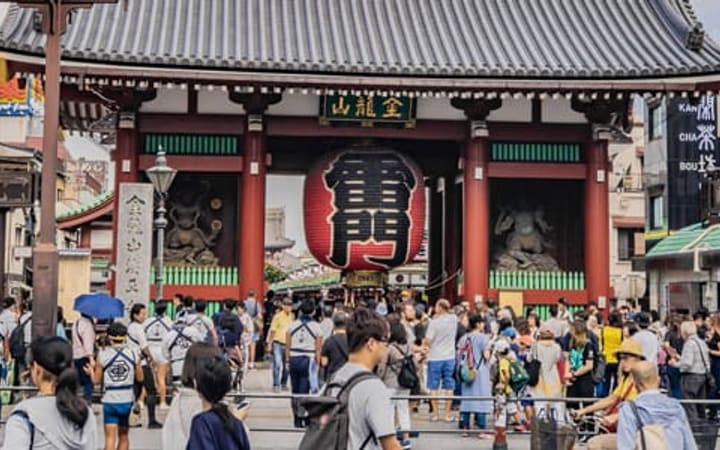
Senso-ji is Tokyo's oldest temple and one of the few big sights in the city that costs nothing at all. You walk in through the red Kaminarimon gate, follow the Nakamise shopping street for about 250 m, pass under the second gate, Hozomon, and reach the main hall. The whole approach takes ten minutes at a stroll, or an hour if you stop for every rice cracker. The main hall keeps set hours, but the grounds do not close, and the evening light-up is the best free show in Asakusa.
Opening hours: the hall closes, the temple does not
People often ask what time Asakusa temple closes, and the honest answer is that it depends on which part you mean. The only fixed hours the temple publishes are for the main hall: 06:00–17:00 from April to September, 06:30–17:00 from October to March. Other halls keep their own hours, and the temple simply says to ask.
The open-air precinct behind the gates has no gate that shuts, and from sunset until about 23:00 every night the main hall, the five-storey pagoda, Hozomon and Kaminarimon are floodlit. The illumination began in 2003 and has run every evening since.
In practice, three windows work well. Early morning, before the Nakamise shutters go up, you share the temple with joggers and people on their way to work who stop to pray. Late afternoon, from about 16:00, the day-trip groups start to leave, though you only have an hour before the hall doors close. After dark the hall is shut but the buildings glow, the shops are closed and the painted shutters on Nakamise come out — more on those below. If you want the view from above, the free 8F terrace of the Asakusa Culture Tourist Information Center across the road is open until 22:00.
From Kaminarimon to the main hall
The route is a straight line north, and each stage has its own story. The temple's own tradition dates everything to 628, when two fishermen brothers, Hinokuma Hamanari and Takenari, pulled a small statue of Kannon out of the Sumida River in their net. The village head, Haji no Nakatomo, recognized it, enshrined it and turned his house into a temple. The monk Shokai built a proper Kannon hall in 645 and declared the statue a hidden image; that is why you will sometimes see "645" in older guides, but it is not the founding date.
Almost everything you see today is post-war. The Tokyo air raid of 10 March 1945 burned the main hall and nearly every building, while the statue itself survived buried about 3 m underground in a bronze vessel. The temple counts about 30 million visits a year — visits, not individual people, but still a lot of feet on a 250 m street.
Kaminarimon, the Thunder Gate
Its full name is Furaijin-mon: the wind god Fujin and the thunder god Raijin guard the front, and two dragon statues stand on the back. The gate had been missing for 95 years after an 1865 fire until Matsushita Konosuke, the founder of Panasonic, paid for the present concrete gate in 1960. The famous red lantern is 3.9 m tall and weighs about 700 kg (older guides say 400 kg; the temple's figure is 700). Look underneath it for the carved dragon on the base — almost nobody does, because they are busy getting the lantern into a selfie.

Nakamise-dori, the market street
Nakamise is the "asakusa market" most people picture: a covered double row of 87 shops (52 on the east side, 35 on the west) selling rice crackers, fans, folding screens, T-shirts and sweets. The right to set up stalls here was given to local residents in return for cleaning the temple grounds; the temple dates it to around 1685, and the shopkeepers' association to the decades after 1688. The red-painted concrete buildings date from 1925, after the 1923 earthquake flattened the brick shops that stood here before.
Most shops open around 09:00–10:00 and close around 18:00–19:00. Come after they close to see the "Asakusa Emaki" shutters, a painted scroll of Asakusa festivals and history spread across the shop fronts, made in 1989 under the painter Hirayama Ikuo.
Hozomon and the main hall
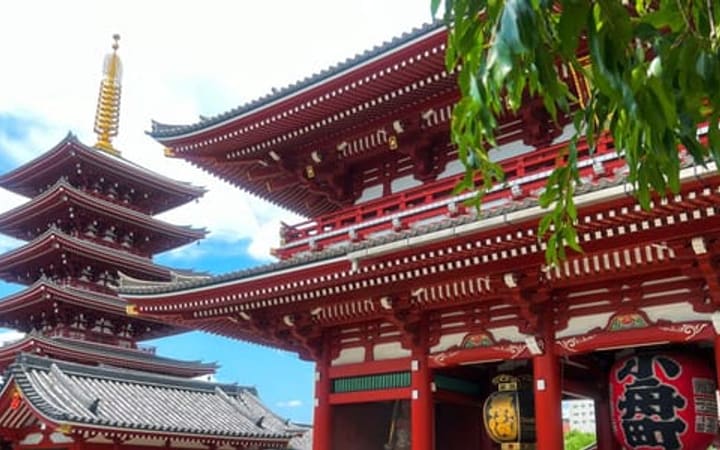
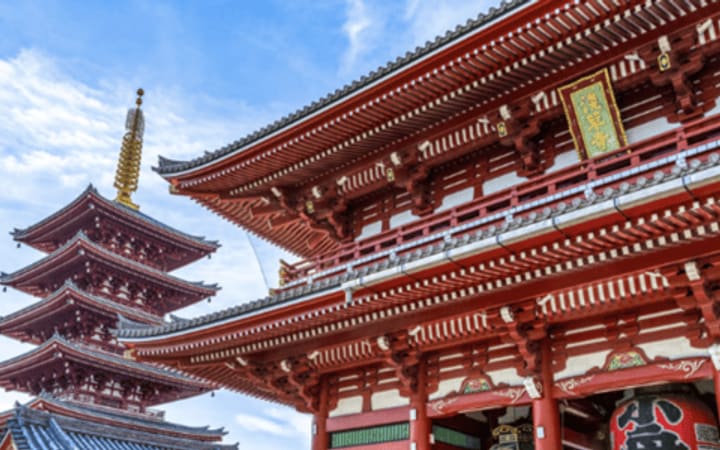
Hozomon (1964) was the old Guardian Gate; its upper floor stores the temple's sutras and treasures. Beyond it, the main hall (1958) is a concrete copy of the 1649 hall that stood for about 300 years until 1945. Step inside and look up: the ceiling paintings include a dragon by Kawabata Ryushi in the center. The statue of Kannon at the heart of the temple is a hidden image that is never shown; a stand-in image is displayed just once a year, on 13 December at 14:00.
There is an elevator on the left (west) side of the main hall and multi-purpose toilets to the right of Hozomon and behind the hall, which helps a lot with strollers.
The five-storey pagoda
The pagoda to the southwest of the hall is 53.32 m from the ground, because it stands on a base building. It was rebuilt in 1973 and holds Buddha relics from Isurumuniya temple in Sri Lanka in the top storey. You cannot climb it; the best photos are from the path between Hozomon and the hall, with the pagoda framed on the left.

Senso-ji or Asakusa Shrine? Two neighbors, two religions
This is the most common mix-up in Asakusa, and search engines add to it by calling the whole complex "Asakusa shrine". Here is the short version:
| Senso-ji | Asakusa Shrine | |
|---|---|---|
| Religion | Buddhist temple | Shinto shrine |
| Honors | Kannon, the bodhisattva of mercy | The three men who found and enshrined the statue |
| Local name | Kannon-sama | Sanja-sama ("the Three Shrines") |
| Oldest building | Main hall rebuilt 1958 | Shrine hall of 1649, survived the war |
| Big festival | Hozuki-ichi (July), Hagoita-ichi (December) | Sanja Matsuri (May) |
Asakusa Shrine stands immediately east of the main hall, inside the same precinct and at the same postal address, which is why so many visitors never notice they have crossed from one faith to another. The hint is the entrance: a torii gate instead of a Buddhist gateway, and at the hall you bow twice, clap twice and bow once — at the temple, you put your palms together quietly without clapping.
The shrine hall is the real antique here. Donated by the shogun Tokugawa Iemitsu in 1649, it survived the fires and the 1945 air raid and is an Important Cultural Property. Its date of founding is unknown; the shrine itself estimates the late Heian to early Kamakura period.

How to visit: incense, omikuji and goshuin
You do not need to know the etiquette to be welcome, but a few habits help:
- Incense. The big bronze burner in front of the hall is for everyone. Buy a bundle, light it, drop it in and waft the smoke toward whatever part of you needs help.
- Purification. At the dragon water spout, rinse your left hand, then your right, then pour water into your palm to rinse your mouth. Never put your lips to the ladle.
- Omikuji fortunes. At the self-service fortune stands, shake the metal box until a numbered stick falls out, then open the drawer with that number. A draw usually costs ¥100 (the temple does not publish the price, so go by the sign on the stand), and the slips have English. Senso-ji is famous for handing out a lot of kyo (bad luck); the temple keeps the traditional ratio on purpose. Tie a bad slip to the rack and leave the bad luck behind.
- Goshuin. The temple's red seal is written at the Yogodo hall on the west side of the grounds, not at the main hall, from 08:00 to 16:30. Two seals are offered, one for Kannon and one for Daikokuten of the Asakusa Seven Lucky Gods, and stamp books are sold there too.
We cover the temple's rules, amulets and online shop in more detail in our Senso-ji review.

Crowds, festivals and the best days
A weekday at 08:00 and a Saturday at 13:00 are two different temples. On a busy weekend afternoon Nakamise moves at shuffle pace and the queue for the incense burner can be three deep. Avoid these if you dislike crowds, or aim for them if you want the energy:
- The 18th of every month, Kannon's fair day, when the main hall is crowded with worshippers.
- New Year (31 December–6 January). In the first three days the temple sets a one-way route and entry restrictions around the gates.
- Sanja Matsuri, run by Asakusa Shrine on the Friday–Sunday around the third Saturday of May, with about 1.8 million people over three days.
- Hozuki-ichi, the ground-cherry market on 9–10 July, with about 100 stalls of potted lantern plants; a visit on 10 July is said to equal 46,000 days of prayer.
- Hagoita-ichi, the battledore market on 17–19 December, when stalls sell decorated paddles.
Other dates to know: the golden dragon dance on 18 March and 18 October, and the White Heron Dance on 3 November.
Eating on Nakamise
Food is half the reason people walk this street slowly. Three snacks worth the pause:
- Age-manju at Asakusa Kokonoe, the third shop from the temple end: fried sweet buns, ¥200 for plain bean paste, ¥250 sesame, ¥300 chestnut.
- Ningyo-yaki at Kimuraya Honten, on the corner nearest the temple, going since 1868. The little cakes come shaped as pigeons, pagodas, lanterns and thunder gods.
- Kaminari-okoshi puffed-rice crackers at Tokiwado, right beside Kaminarimon, a shop founded in 1816.
Eating while walking on Nakamise is asked to be avoided — not a law, but signs, announcements and shop staff will remind you. Stand in front of the shop, finish, and hand your rubbish back. For proper meals nearby, including tendon on Denboin-dori and the jumbo melon pan just west of the main hall, see our Asakusa food guide. If you prefer a beer and a stew, Hoppy Street is two minutes west of the temple grounds.
With a guide, or in a kimono
The temple needs no guide to enjoy, but a good one will point out the dragon under the lantern, the Iemitsu-era shrine and the backstreets you would otherwise skip. Most paid tours last about two hours and start at Kaminarimon.
Prices are the lowest option the platform shows, in US dollars, and move with dates and exchange rates. The booking page is final. Prices checked: September 28, 2026.
The first tour meets at the Tokiwado cracker shop by Kaminarimon, spends about 30 minutes in the temple and continues to Asakusa Shrine and Hoppy Street. If you would rather not pay, free volunteer tours in English leave from the Tourist Information Center on several days a week; details and alternatives are on our walking tours page.
A kimono makes the temple photos, and the rental shops are clustered within five minutes of Kaminarimon. Our kimono rental guide and the comparison of the big Asakusa rental shops explain what is included and how long dressing takes. If walking is not your plan, a rickshaw ride is the lazy way round the neighborhood.
Getting to Senso-ji
Four stations carry the name Asakusa. The Toei Asakusa Line (Exit A4), the Ginza Line and the Tobu Skytree Line all put you about 5 minutes' walk from Kaminarimon. The Tsukuba Express station is a separate one on Kokusai-dori, west of the temple; it is closer to Hanayashiki than to the gate. The temple has no car park. Our getting-there guide covers airport trains and day passes.
Directly under the station corner, two minutes from Kaminarimon, is the Asakusa Underground Street, Japan's oldest surviving underground arcade — a good place for a cheap bowl of noodles after the temple.
See the Senso-ji walking tour from US$22.26 · GetYourGuide