
Asakusa is in Taito City, on the north-east fringe of central Tokyo, where the old "Shitamachi" low city meets the Sumida River. Tokyo Skytree stands just across the water in Sumida City. By train, it is the last stop on the Ginza Line, Tokyo's oldest subway - about 15–20 minutes from Tokyo Station, three stops from Ueno and about half an hour from Shibuya or Shinjuku. From both airports, trains on the Toei Asakusa Line bring you right to Kaminarimon without changing.
The one thing that confuses first-timers: there are four stations called "Asakusa", run by four different companies, and one of them is 600 m away from the others. This page sorts them out.
The four Asakusa stations
Three of them are clustered together at the Kaminarimon end of the neighborhood, by Azumabashi bridge:
- Tokyo Metro Ginza Line - Asakusa. The terminus of Japan's first subway, which opened on 30 December 1927 between Ueno and Asakusa, 2.2 km long. Exits 1 and 2 put you on Kaminarimon-dori; Exit 2 is one minute from the Tourist Information Center opposite the gate.
- Toei Asakusa Line - Asakusa. The line that runs through to both airports. Exit A4 is the one for Kaminarimon and Senso-ji, about five minutes on foot.
- Tobu Skytree Line - Tobu Asakusa. Inside the EKIMISE / Matsuya building at 1-4-1 Hanakawado. This is the Tokyo terminus for Tobu's limited expresses to Nikko and Kinugawa Onsen, and one stop from Tokyo Skytree station.
The fourth is on its own:
- Tsukuba Express - Asakusa. A separate station under Kokusai-dori at Nishi-Asakusa 3-1-11, about 600 m west. Exit A1 is for Senso-ji and Kokusai-dori, Exit A2 for Nishi-Asakusa 3-chome. It is the closest station to Don Quijote, Hoppy Street and the Imahan sukiyaki restaurant - and about ten minutes from Kaminarimon.
Senso-ji itself lists the Ginza, Tobu and Tsukuba Express stations as five minutes' walk from the temple, and Toei as five minutes from Exit A4. In practice, the Ginza Line and Toei stations put you at Kaminarimon; the Tsukuba Express drops you on the Rokku side, near Hanayashiki.
- Asakusa Stn (Ginza/Asakusa/Tobu)
- Asakusa Stn (Tsukuba Express)
- Asakusa water-bus pier
- Kaminarimon
- Tourist Information Center
- Senso-ji Main Hall
- Don Quijote Asakusa
There is also Tawaramachi, the Ginza Line stop before Asakusa. It is handy for Kappabashi kitchen street and for the Imahan restaurant on Kokusai-dori (Exit 3, about seven minutes), but for the temple, stay on to Asakusa.
Routes at a glance
Times below are typical journey times from route planners, so treat them as "about". Official fares are given where the operator publishes them.
| From | Route | Change? | Time | Fare |
|---|---|---|---|---|
| Ueno | Ginza Line, 3 stops | No | a few minutes | Subway fare |
| Tokyo Station | JR to Kanda, then Ginza Line | Once | about 15–20 min | - |
| Shibuya | Ginza Line end to end | No | about 33–34 min | about ¥260 (¥252 IC) |
| Shinjuku | JR Chuo Line to Kanda, then Ginza Line | Once | about 27–30 min | about ¥340 |
| Akihabara | Tsukuba Express to TX Asakusa | No | about 4–5 min | ¥230 |
| Haneda Airport | Keikyu through-train onto Toei Asakusa Line | No | about 36–52 min | about ¥650 (¥635 IC) |
| Narita Airport | Keisei Access Express onto Toei Asakusa Line | No | about 52 min fastest, usually 60–75 min | ¥1,290 (¥1,276 IC) |
| Odaiba Seaside Park | Tokyo Cruise water bus | No | about 50–65 min | ¥2,000 |
| Hinode Pier | Tokyo Cruise water bus | No | about 40 min | ¥1,000 |
| Nikko | Tobu SPACIA X limited express | No | about 1 h 50 min | about ¥3,340 |
The Ginza Line from Shibuya is the quiet winner: you board at one end, sit down, and get off at the other. Ginza, Nihombashi, Kanda and Ueno are all on the way, so it doubles as a cross-section of old Tokyo.
From Haneda and Narita airports
Asakusa is one of the easiest places in Tokyo to reach from the airports, because the Toei Asakusa Line is joined up with the private railways that serve them.
Haneda. Keikyu Airport Line trains run through at Sengakuji onto the Toei Asakusa Line and on to Asakusa, with no change and no express surcharge. Many do; there is one about every ten minutes. The faster Airport Kaitoku and Kaitoku services take about 36–45 minutes, ordinary expresses about 47–52. The fare is about ¥650, a little less with an IC card. Check the destination on the platform display: not every train from Haneda continues past Sengakuji, and if yours stops there, change across the platform.
Narita. The Keisei Access Express runs from Narita Airport (Terminal 1 and 2) via the Narita Sky Access line straight onto the Toei Asakusa Line to Asakusa - again, no change and no surcharge. Keisei's official fare is ¥1,290 by ticket or ¥1,276 by IC card (children ¥650 / ¥638). The fastest runs take about 52 minutes; allow 60–75. The Skyliner is quicker to central Tokyo but means changing trains; with luggage, the one-seat ride usually wins.
Both routes arrive at the Toei station. Take Exit A4 for Kaminarimon, or A5 for the EKIMISE building and Tobu station. Hotels on the Kaminarimon and Komagata side are a short walk - see our where to stay in Asakusa guide for which area suits you.
The Tokyo Subway Ticket
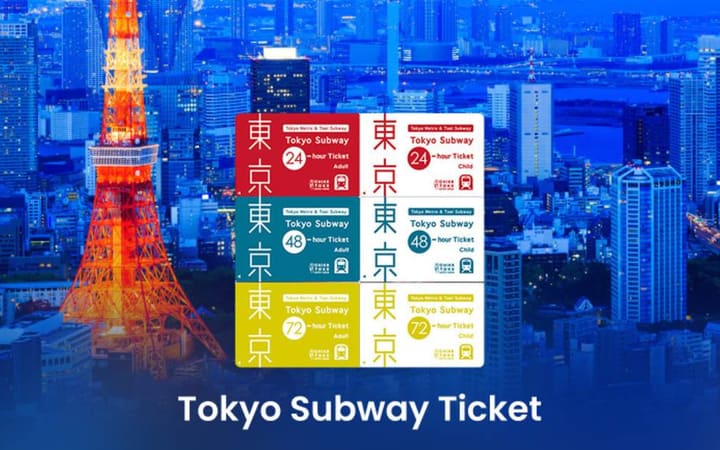
If you are spending a day or more riding around Tokyo, the Tokyo Subway Ticket covers all Tokyo Metro and Toei subway lines, which includes the Ginza Line and the Toei Asakusa Line. It is sold to overseas visitors. Current prices:
| Ticket | Price (adult) |
|---|---|
| 24 hours | ¥1,000 |
| 48 hours | ¥1,500 |
| 72 hours | ¥2,000 |
These went up recently; the old ¥800 / ¥1,200 / ¥1,500 prices are still all over the internet. The hours run from first use, not by calendar day.
Is it worth it? A single Ginza Line hop from Shibuya is about ¥260, so the 24-hour ticket pays for itself on four subway rides in a day - an easy target if you go Asakusa to Ueno to Ginza to Shibuya. What it does not cover: JR lines (the Yamanote Line included), the Tobu line to Skytree and Nikko, the Tsukuba Express, and the Keikyu and Keisei sections to the airports. If you ride the Toei line in from Haneda or Narita on your pass, you still pay the airport railway's portion.
You can reserve it on Klook and collect or activate it in Tokyo:
Prices are the lowest option the platform shows, in US dollars, and move with dates and exchange rates. The booking page is final. Prices checked: September 28, 2026.
For a longer stay with lots of JR travel, a rechargeable IC card (Suica or PASMO) may suit you better, since it works on everything - including Tobu, the Tsukuba Express and Don Quijote's tills.
By water bus on the Sumida River
The most scenic way to arrive is by boat. Tokyo Cruise (Tokyo Cruise Ship Co.) runs water buses from Asakusa pier, at 1-1-1 Hanakawado beside Azumabashi bridge, one minute from the Ginza Line and Tobu stations.
- Asakusa - Hinode Pier: ¥1,000 adult / ¥500 child, about 40 minutes.
- Asakusa - Odaiba Seaside Park: ¥2,000 adult / ¥1,000 child on the Leiji Matsumoto-designed boats Himiko (about 50 min), Emeraldas (about 55 min) or Hotaluna (about 65 min).
- Asakusa - Hama-rikyu garden: ¥1,180 including garden admission, about 35 minutes. This stop cannot be booked online; tickets are sold only from the machines at Asakusa pier.
Children are 6–11; one infant aged 1–5 rides free per adult. Each of the three futuristic boats has monthly no-sail days (Himiko the second Tuesday and following day, Hotaluna the third, Emeraldas the fourth), so check the operator's timetable before you plan around a specific departure. The other Sumida water bus, the Tokyo Mizube Line, is suspended - don't plan on it.
A good way to use it: arrive in Asakusa by metro in the morning, see the temple, and leave by boat after lunch for Odaiba. Our Sumida Park and River guide covers the riverside, and the Tokyo Cruise review explains booking and cancellation rules.
Loading live availability from GetYourGuide…
Once you arrive: which exit
Asakusa is small enough to walk, but the wrong exit can cost you ten minutes. A cheat sheet:
- Kaminarimon and Nakamise: Ginza Line Exit 1 or 2; Toei Exit A4.
- Tourist Information Center (free 8th-floor terrace, open 09:00–22:00): Ginza Line Exit 2, one minute.
- Tobu trains, EKIMISE, the small Don Quijote: Ginza Line Exit 7; Toei Exit A5.
- Komagata riverside and the unagi restaurant Maekawa: Toei Exit A2; Ginza Line Exit 4.
- Don Quijote, Hoppy Street, Rokku, Hanayashiki: Tsukuba Express Exit A1.
- Water-bus pier: any Ginza Line or Tobu exit toward Azumabashi, one minute.
Right beside the Ginza Line gates is the Asakusa Underground Street, Japan's oldest surviving underground shopping arcade, with a standing soba bar and a yakisoba stall - worth a look on your way up.
Toei buses and Taito City's "Megurin" loop bus also stop near Senso-ji, useful if you are coming from Ueno's museums with tired legs.
Leaving Asakusa: Skytree, Ueno and Nikko
- Tokyo Skytree: one stop on the Tobu Skytree Line from Tobu Asakusa, or about 20 minutes on foot from Senso-ji across Azumabashi or Komagatabashi.
- Ueno: three stops back along the Ginza Line.
- Akihabara: four to five minutes on the Tsukuba Express from the Kokusai-dori station.
- Nikko: Tobu's SPACIA X limited express from Tobu Asakusa takes about 1 hour 50 minutes; standard seats cost about ¥3,340, all reserved.
Our nearby guide covers what to do at each. If you'd rather have someone else handle the logistics for your first morning, a guided Asakusa walk starts at Kaminarimon, a few steps from the Ginza Line exits - our walking tours guide compares them, and GetYourGuide lists them all: